Intel vs AMD: Which Is Better for Your Next Build?
Building a new PC means making one of the most important decisions first: choosingbetween Intel and AMD. Whether you're aiming to max out frame rates for gaming or need aprocessor that powers through video editing or multitasking, your CPU choice sets the tonefor your entire build.
At Dave’s Computers custom PC services in NJ, we help customers across New Jersey figure out which processor fits their needs best. With so many options and evolving hardware specs, it can feel overwhelming. That’s why we’ve broken it down in this easy-to-follow guide. We’ll compare Intel and AMD across gaming, productivity, power efficiency, and budget to help you find the right fit for your system, without the jargon or guesswork.
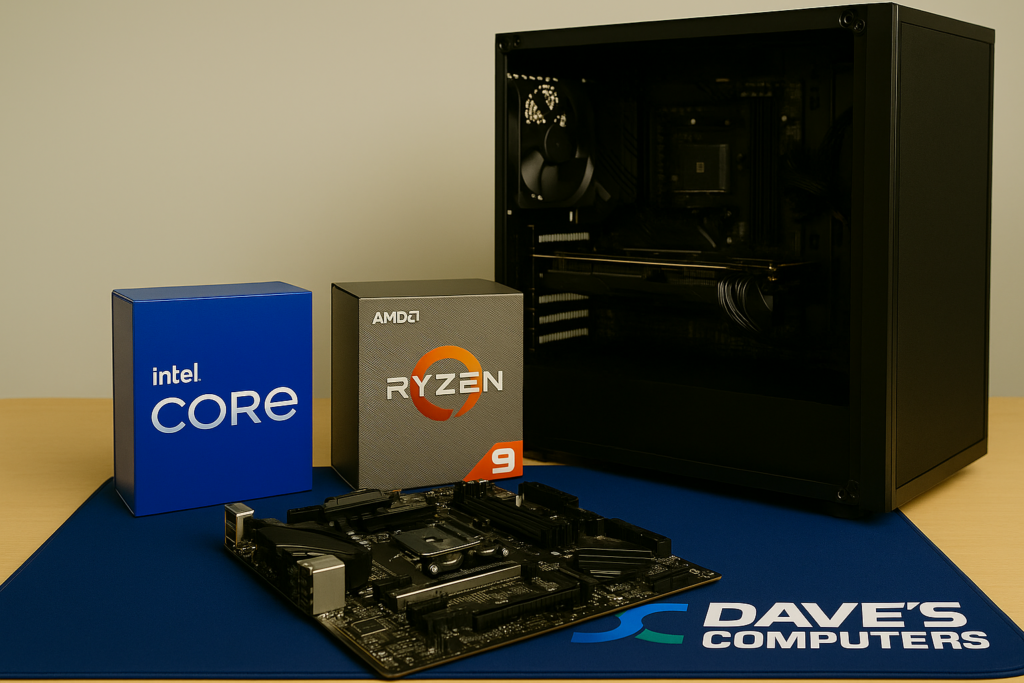
Intel vs AMD: Core Differences Today
Intel and AMD dominate the CPU market, but they take different approaches when it comes
to architecture, compatibility, and upgrade paths. Understanding how these differences
affect your build will help you make a smarter investment, especially if you're choosing
between the Intel Core and AMD Ryzen series.
Intel’s latest Core Ultra 200 Series (Arrow Lake) introduces a hybrid core architecture with enhanced AI performance via integrated NPU, support for DDR5-6400, PCIe 5.0, and built-in Intel Xe-LPG graphics. These chips are designed for modern productivity and AI tasks, offering 24 cores (8P+16E) and seamless integration with Windows 11 Copilot+ features.
AMD counters with the Ryzen 9000 Series, based on the Zen 5 architecture, providing up to 16 cores and 32 threads, higher IPC (instructions per clock), and wider platform stability thanks to ongoing AM5 socket support. Though AMD lacks dedicated NPUs, it delivers exceptional multithreaded performance, ideal for creators, professionals, and power users.
Gaming CPUs: Which Performs Better?
If you're building a gaming PC and want to avoid the most common PC building myths debunked, the CPU you pick plays a big role in frame rates, load times, and overall responsiveness. Both Intel and AMD offer strong options, but their strengths differ depending on your gaming style and whether you also stream, multitask, or plan to upgrade down the road.Intel for Gaming:
Higher single-thread performance for esports titles like Valorant and CS2
Built-in Arc iGPU for entry-level gaming without a discrete GPU
AI-enhanced frame pacing and streaming optimization with Copilot+
AMD for Gaming:
More cores and threads ideal for simultaneous gaming and streaming
Ryzen 9 9950X and 9950X3D offer industry-leading gaming performance
Longer socket support means easier CPU upgrades on AM5 boards
Independent testing shows that Ryzen 9 9950X consistently delivers up to 18% better performance in modern AAA titles than Intel’s Core Ultra 9 285K, especially when paired with high-end GPUs. AMD’s 3D V-Cache variants also offer major advantages in titles like Baldur’s Gate 3 and Horizon: Forbidden West.
Productivity and AI Integration
In 2025, productivity requires more than just raw clock speed. Today’s workloads include AI-assisted tools, remote collaboration, and media editing — and CPUs must keep up.
Intel Core Ultra 200 Series:
Integrated NPU offers up to 13 TOPS for real-time AI tasks (image editing, transcription, video effects)
Hybrid core layout optimizes power use across apps like Photoshop, Office 365, and Zoom
Designed for desktop productivity tasks, with partial AI acceleration but not Copilot+ certified.
AMD Ryzen 9000 Series:
Delivers superior performance in multi-threaded workflows like 4K video rendering, code compilation, and simulation
Still unmatched in raw core power, with 16-core CPUs available even on mid-range boards
AM5 motherboards support ECC memory and extended PCIe 5.0 lanes for demanding workflows
Benchmark Insights:
While Intel leads in AI-specific operations, such as background blur and speech enhancement via NPU, AMD dominates in conventional productivity, outperforming Intel by 20–30% in Blender, Premiere Pro, and DaVinci Resolve workloads.
Budget and Upgrade Path Considerations
Whether you’re building your first PC and want to avoid common mistakes when building a custom PC or refreshing an older system, cost matters. But it’s not just about the sticker price of the CPU, it’s about the entire build. That includes your motherboard, memory, cooling solution, and whether your components will still be compatible for future upgrades.AMD Ryzen 9000 Series:
AM5 socket support since 2022 — backward and forward compatibility confirmed through at least 2026
Offers better value per core and unlocked performance on budget chipsets (e.g., B650)
Great for users upgrading from Ryzen 7000 or 8000 without needing a new board
Intel Core Ultra 200 Series:
New LGA 1851 socket requires entirely new motherboards and BIOS support
Supports cutting-edge features: Wi-Fi 7, Thunderbolt 4, and higher DDR5 speeds
Ideal for fresh builds focused on AI workloads, power efficiency, and mobility
Cost Comparison:
For a performance-class build, AMD’s total platform cost (CPU + board + RAM) is typically 10–15% lower, especially if reusing an AM5 board. However, Intel delivers added value through its AI integrations and laptop-class battery efficiency, especially in ultrabooks and small form factor builds.
Thermal Efficiency and Power Consumption
Thermal design and power efficiency are now major differentiators in the high-performance CPU market.
AMD's Ryzen 9000 Series maintains a strong lead in performance-per-watt, especially in multi-core rendering and video workloads. TDPs range from 65W to 170W across the lineup.
Intel’s Core Ultra 200 Series uses a hybrid core layout to manage power intelligently, especially in mobile systems — but desktop SKUs often run hotter under sustained load.
Cooler Requirements:
AMD chips tend to work well with standard air coolers, while top-end Intel chips may require 240mm+ AIO cooling for peak stability.
Real-World Recommendations
Choose Intel if:
You need access to the latest ports and features like Thunderbolt 4 and Wi-Fi 7
You want integrated graphics for office tasks or light workloads without a GPU
You’re building a general-purpose system for productivity, web, and basic AI tasks
You use software that benefits from a built-in NPU, like video calls with background blur
You want smooth multitasking with Intel’s hybrid P-core and E-core architecture
You’re building from scratch and prefer a platform with cutting-edge I/O support
Choose AMD if:
You want the best gaming performance, especially with a dedicated GPU
You need strong multi-threaded power for video editing, rendering, or 3D workloads
You plan to use high-speed DDR5 memory (up to 8000+ MT/s with overclocking)
You value long-term socket support with the AM5 platform for future upgrades
You prefer air or mid-range liquid cooling without thermal issues
You want the best price-to-performance ratio for the full platform (CPU, board, RAM)
What Is Ryzen AI?
Note: The following sections describe laptop-only CPUs and are not relevant for desktop builds.With growing demand for AI acceleration, AMD released the Ryzen AI 300 Series (not to be confused with desktop Ryzen 9000). These new laptop chips, based on Strix Point, integrate:
A dedicated XDNA 2 NPU with 50+ TOPS of AI compute
12 Zen 5 CPU cores
Integrated RDNA 3.5 GPU
This platform is AMD’s answer to Intel’s Lunar Lake for laptops — and a key milestone for upcoming Ryzen AI for desktop, which is expected in 2026.
Intel AI Processors in 2025
Intel now offers multiple AI-ready laptop chips, not desktop CPUs with Copilot+ support:
Core Ultra (Meteor Lake) – Laptops, Gen 1 NPU
Core Ultra 200 (Arrow Lake) – Desktops, Gen 1 NPU
Lunar Lake (Coming late 2025) – Laptops, Gen 2 NPU
If you want a future-proof AI desktop today — Intel Arrow Lake is your best option. For laptops, Lunar Lake will likely dominate in the second half of 2025.
Looking Ahead: The Future of AI in CPUs
By the end of 2025, both Intel and AMD are expected to offer AI-capable chips across both desktops and laptops.
Intel’s roadmap confirms Lunar Lake and Panther Lake with advanced AI performance
AMD is expected to launch Ryzen AI 9000 for desktops with NPUs
Windows 12 (or major 11 updates) will likely push real-time AI features even further — meaning future CPUs must handle these tasks locally.
At Dave’s Computers, we’re here to help you choose with confidence. Whether you’re building your first gaming rig or upgrading a work setup, our local team can match you with the right CPU for your goals. Reach out today or stop by our New Jersey shop. We’ll make sure your next build runs fast, cool, and exactly how you want it.